
Every unplanned tool change in high-volume machining, scrapped part, and lost minute has a dollar figure attached to it. The faster you can pinpoint the root cause of underperformance, the faster you can protect your line. Most cutting tool failures follow recognizable patterns — and a structured diagnostic approach gets you to the fix quickly.
Here's where to start.
Step 1: Establish Your Baseline
Precise diagnosis starts with precise data. Pull your current numbers: holes per tool, cycle time, scrap rate, and tool change frequency. Without a clear baseline, you're troubleshooting by feel.
Once you have the data, identify which symptom is driving the problem — shortened tool life, out-of-spec holes, elevated scrap, heat buildup, chip evacuation issues, or unexpected breakage. Each point is in a different direction.
Step 2: Read the Wear Pattern
Examine tools before discarding them. Wear patterns are diagnostic information. Use the diagram below as a quick reference guide the next time you pull a worn tool.
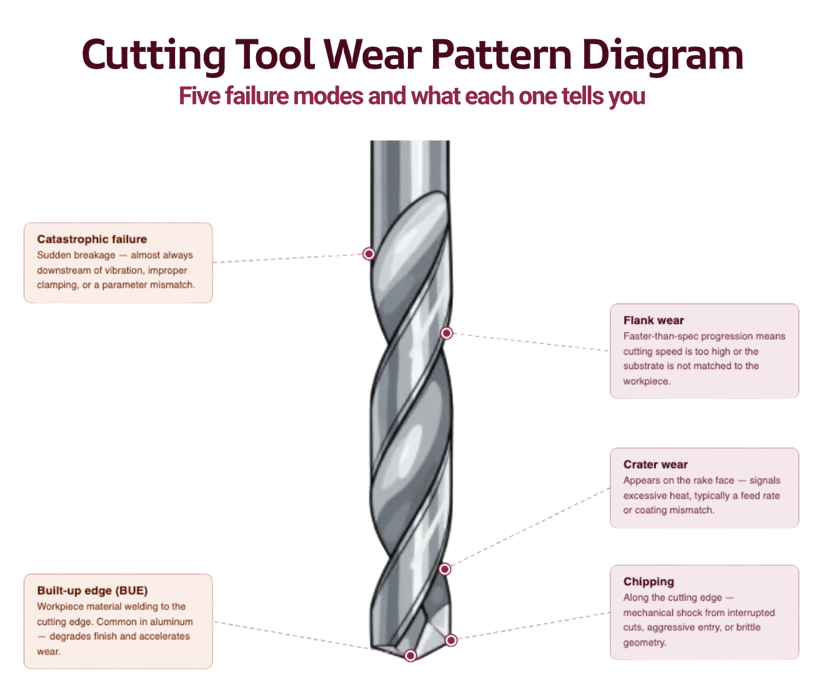
Document and photograph wear consistently. Over time, this library becomes your fastest diagnostic reference.
Step 3: Analyze Your Parameters
Parameters are the most common culprit — and the easiest to adjust. Before replacing the tool, work through this checklist:
- Cutting speed: Verify it falls within the recommended range for your specific workpiece material. Too fast accelerates thermal wear; too slow promotes BUE in aluminum and similar materials.
- Feed rate: Too aggressive increases chipping risk; too conservative increases heat and rubbing wear.
- Depth of cut: Confirm you're not overloading the tool per pass.
- Coolant delivery: Verify coolant is reaching the cutting zone — not just the surrounding area. Misdirected or degraded coolant is a frequent contributor to premature failure that often goes unchecked.
If wear persists with these cutting parameter optimizations, move to material and coating evaluation.
Step 4: Match Material and Coating to the Application
Coating and substrate selection directly determine how a tool handles heat, friction, and wear in a given material. The comparison below breaks down the four primary substrate options and when to reach for each one.
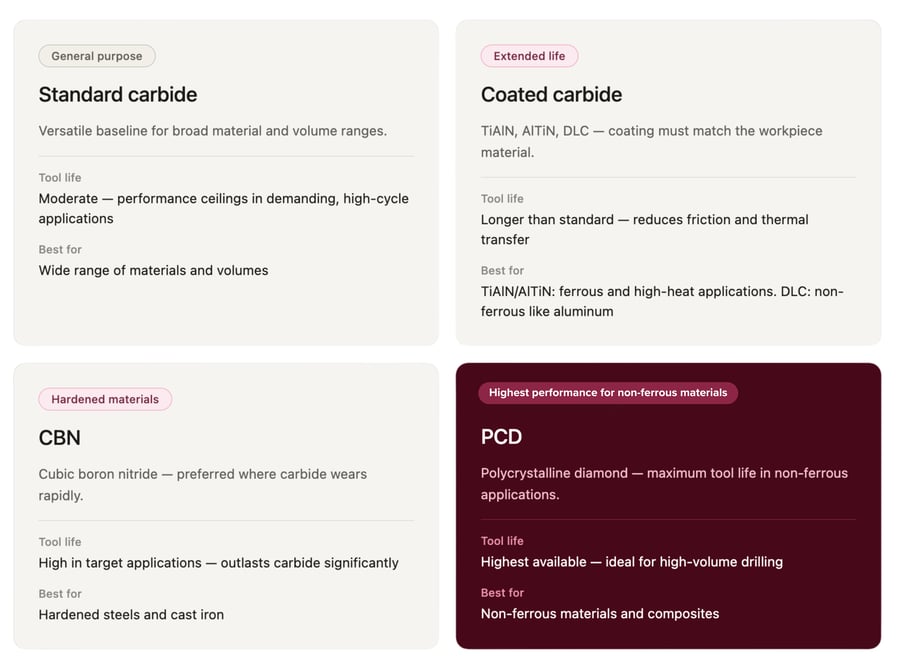
When your wear analysis and parameter audit both come back clean, a material or coating upgrade is typically the highest-leverage next move.
Step 5: Address Heat and Chip Evacuation
Heat accelerates every wear mechanism in parallel. Evaluate coolant concentration and condition first — degraded coolant is a surprisingly common root cause. Then assess delivery method: through-spindle coolant reaches the cutting zone far more effectively than flood coolant in deep-hole applications. A modest reduction in cutting speed can also meaningfully reduce thermal load when other adjustments fall short.
Chip evacuation failures cause re-cutting, which damages the cutting edge and the workpiece surface simultaneously. In drilling, chip packing is a leading cause of sudden tool breakage. Check flute geometry for compatibility with your chip load, review peck drilling cycles in deep-hole applications, and evaluate coolant pressure for blind-hole work.
If heat and evacuation issues persist after these adjustments, tool geometry is the likely constraint.
Step 6: Know When to Escalate
Regrinding and retipping make sense when tools are worn but geometrically sound. Precision regrinding — performed to original specification — extends tooling investment and defers replacement costs without sacrificing performance.
Custom geometry is the right call when off-the-shelf tools consistently fall short in a specific application. A tool engineered around your part prints, material, and cycle time removes the performance compromises built into general-purpose designs and can consolidate the number of tools your operation requires.
Higher-performance substrates — PCD, CBN, or advanced coated carbide — become the logical move when tool life is the binding constraint and your cost per hole no longer works with standard tooling.
Work the Process
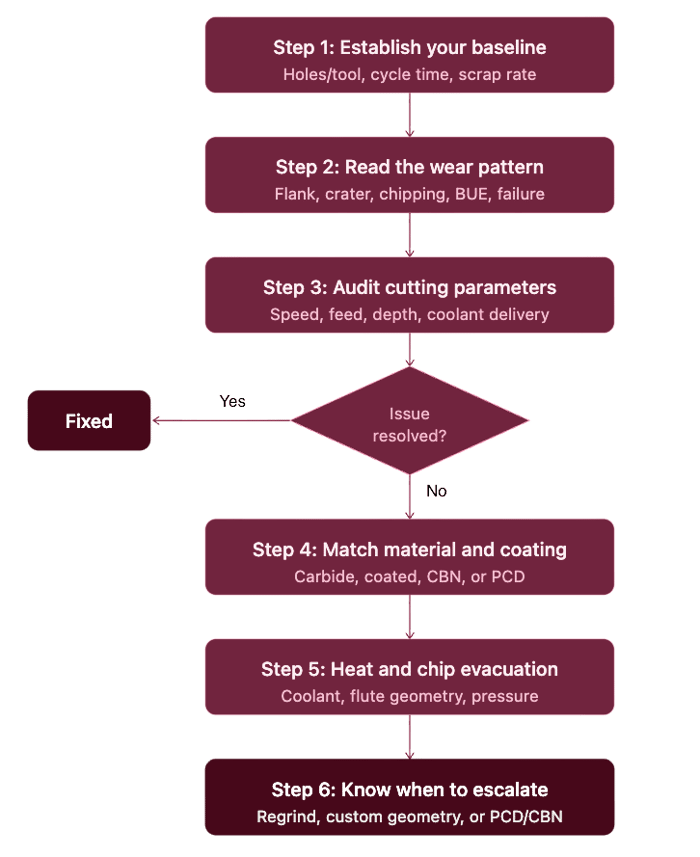
A structured diagnostic approach — baseline data, wear analysis, parameter audit, material match, heat and chip management — surfaces the root cause reliably.
Work through the diagnostic flowchart below — step by step — to identify where your operation is breaking down and what to do about it.
Still troubleshooting? Our engineers work directly with your part prints, materials, and cycle times to find the right solution - fast.